

English
- English
- Русский
TENGYU DYNAMIC
Specializing in silicone adhesive and sealant research and development, production, sales in one of the national high-tech enterprises

How to distinguish between one-component and two-component silicone sealants?
2024-08-19 13:06:37
Click:
“
Silicone sealants are widely used for bonding and sealing of expansion joints in high-rise buildings, as well as waterproofing and sealing of joints in doors, windows, kitchens, and bathrooms, due to their excellent weather resistance, high and low temperature resistance, good adhesion, and biochemical compatibility.
”
One-component silicone sealant is made by mixing the base polymer, filler, crosslinking agent, tackifier and catalyst in a moisture-proof mixer and packaging them in a sealed tube or hose. When in use, just squeeze the rubber with a glue gun, and it will react with moisture in the atmosphere to form an elastomer.
The curing of one-component silicone sealant is carried out gradually from the surface to the inside with the help of moisture in the air. First, the moisture in the air reacts chemically with the hydrolyzable groups in the cross-linking agent to form a substance with active hydroxyl groups, which further undergoes a condensation reaction with the hydroxyl groups in the base polymer to form a three-dimensional network of elastomers.
The vulcanization of one-component silicone sealant is related to the type and structure of the cross-linking agent and catalyst, as well as the ambient temperature and humidity. Its vulcanization speed depends largely on the diffusion rate of water in the adhesive layer. The same formula will cure faster in the high temperature environment in summer, but much slower in winter. When the ambient humidity is high, there is enough water to participate in the condensation reaction, so the curing speed will be faster than that under low humidity conditions. However, since the curing process develops gradually from the surface to the inside, and the curing speed becomes slower and slower from the surface to the inside, it takes quite a while to achieve deep curing.
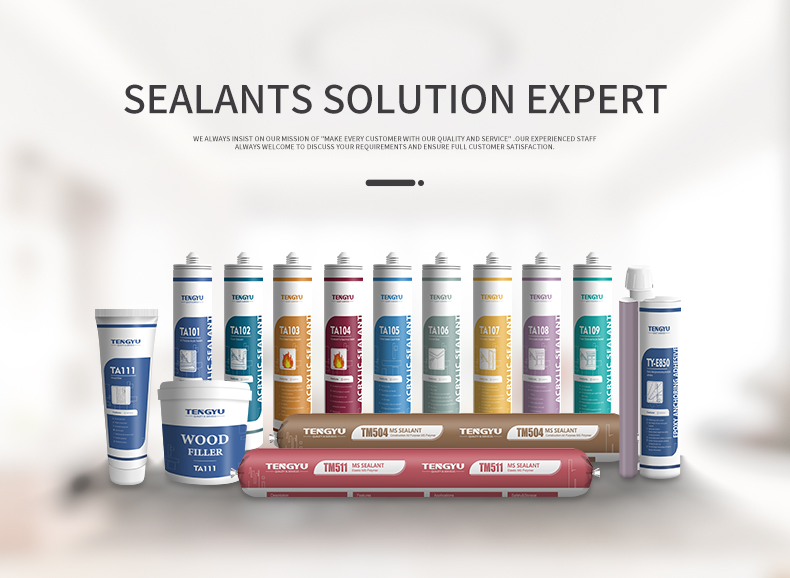
Two-component silicone sealant is a sealable storage of components A and B according to their chemical properties. Generally, component A contains base polymer and filler, and component B contains filler, crosslinker and catalyst. When using, use a glue gun to mix components A and B in a certain proportion, and condensation reaction will occur to crosslink into an elastomer.
The curing process of two-component silicone sealant is to initiate or promote the condensation reaction between the base polymer and the cross-linking agent under the action of the catalyst. Therefore, its vulcanization speed mainly depends on the type, dosage and temperature of the catalyst. Generally speaking, as the amount of catalyst increases, the vulcanization speed increases, but the service life becomes shorter. It takes about 1 day for the two-component silicone sealant to fully cure at room temperature. If the temperature is increased, the vulcanization speed can be greatly increased. However, further maintenance is required to produce strong adhesion with the substrate.
Prev : What causes silicone sealant to crack after curing?
Next : What are the properties and precautions of neutral silicone sealant?
Related Articles
Quality Control in Sealant & Waterproof Coating Manufacturing | From Raw Materials to Finished Products
What Is No More Nails? No More Nails vs Silicone Sealant Explained
Silicone Sealant Yellowing: How to Avoid Discoloration in Clear Caulk
What Is No More Nails? Uses, Strength & How to Apply It
Floor Adhesives: A Comparative Guide to Acrylic, MS, and Polyurethane
You May Also Like
-
top Reco Quality Control in Sealant & Waterproof Coating Ma...

-
top Reco What Is No More Nails? No More Nails vs Silicone S...
nail free glue 
-
top Reco Silicone Sealant Yellowing: How to Avoid Discolora...
silicone sealant 
-
top Reco Which sealant is more mold resistant polyurethane ...
silicone sealant acrylic sealant pu sealant 
-
Hydrophilic Waterstop Polyurethane Sealant for Con...

-
MS Polymer Wood Flooring Adhesive: Product Selecti...

 Tina
Tina Tina
Tina
