

English
- English
- Русский
TENGYU DYNAMIC
Specializing in silicone adhesive and sealant research and development, production, sales in one of the national high-tech enterprises

Case Analysis: Adhesive Failure or Cohesive Failure — When Is the Adhesive Really to Blame?
2025-12-20 09:05:00
Click:
“
Learn the difference between adhesive failure and cohesive failure, discover how insufficient curing leads to cohesive failure, and explore real-world adhesive failure analysis cases.
”
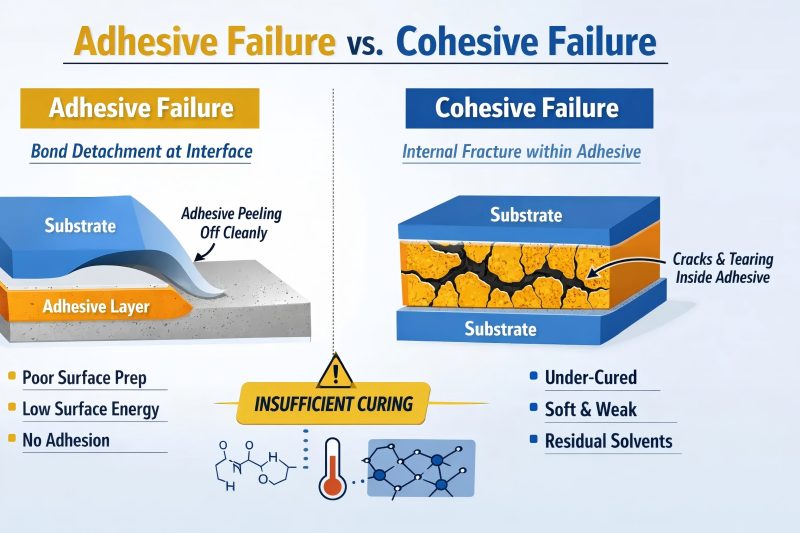
Failure analysis of bonded assemblies is inherently challenging due to the interaction of multiple factors, including substrates, interfacial conditions, processing parameters, and service environments. As a result, responsibility attribution is often unclear.
Across many real-world cases, when the failure is eventually traced back to the adhesive itself, the root cause can often be summarized by one critical issue: insufficient curing. This is not simply a matter of the adhesive 'not being fully dry.' Instead, it is a systematic problem involving reaction completion, polymer network integrity, and the direct link between curing degree and final performance.
Typical Case Studies
Case 1: Automotive Sensor Detachment
An onboard automotive sensor detached from its substrate after road testing. Material analysis revealed an abnormally low glass transition temperature (Tg) and excessive solvent residue within the adhesive layer.
Conclusion: Severe under-curing of the adhesive resulted in cohesive failure within the adhesive layer.
Root cause: The baking temperature on the production line did not meet the specified process requirements.
Case 2: Electrical Insulation Failure of Potting Compound Causing Short Circuit
In a new-energy vehicle motor controller, the potting compound exhibited electrochemical migration, leading to burnout of the power module. Thermal analysis and compositional testing showed non-uniform crosslink density and a high concentration of mobile ionic residues.
Conclusion: Improper curing conditions caused uneven and incomplete curing, ultimately leading to cohesive failure of the potting compound.
Case 3: 'Soft Core' Failure of Structural Sealant in Curtain Wall Systems
Curtain wall glass panels detached during strong wind conditions. When the sealant was cut open, the interior remained uncured. Infrared spectroscopy confirmed the absence of characteristic crosslinker peaks in the deep layers of the sealant.
Conclusion: The moisture-curing structural sealant failed to fully cure under low winter temperatures and premature assembly, resulting in severe cohesive failure, commonly known as 'soft core' failure.
Case 4: Rapid Sole Separation in Sports Shoes
Shortly after use, the sole of newly purchased sports shoes separated from the upper. The adhesive at the failure interface remained tacky. Testing revealed low cohesive strength and the presence of unreacted curing agent components.
Conclusion: Insufficient curing led primarily to cohesive failure, characterized by a “surface-dry but internally uncured” adhesive layer, likely caused by inadequate drying and pressing time during production.
From these cases, it is evident that failure responsibility is often difficult to determine in the early stages. Is the issue adhesive failure at the interface, cohesive failure within the adhesive, improper application, or poor substrate compatibility?
This uncertainty frequently leads to disputes and delays, while the true root cause remains hidden. One key challenge is that curing degree is a microscopic parameter that cannot be reliably assessed by visual inspection alone.
Microscopic Mechanisms of Insufficient Curing: Why Cohesive Failure Occurs
At the microscopic level, adhesive curing is the process by which chemical reactions form a three-dimensional polymer network. Insufficient curing means this network is incomplete or defective, directly leading to cohesive failure.
01 Weak Polymer Network Structure
Low crosslink density or short polymer chains cannot effectively distribute applied stress. Stress concentrates locally, triggering microcracks that rapidly propagate, resulting in low cohesive strength.
02 Residual Low-Molecular-Weight Components
Unreacted monomers, solvents, or other small molecules remain trapped within the network. These residues weaken intermolecular forces, increase chain mobility, and reduce mechanical strength. They also create pathways for ion migration, solvent attack, and thermal softening, accelerating aging and degradation.
03 Reduced Glass Transition Temperature (Tg)
Incomplete crosslinking lowers Tg by allowing polymer chains to move more easily. At service temperatures—especially elevated temperatures—the adhesive may prematurely enter a rubbery or viscous state, losing load-bearing capacity and failing through creep or softening.
In summary, insufficient curing produces a non-uniform, defect-rich, and thermodynamically unstable polymer network. While the adhesive may still adhere well to substrates, its internal weakness inevitably manifests as cohesive failure under mechanical or environmental stress.
Systematic Response Strategy: From Troubleshooting to Root-Cause Prevention
01 Preliminary Self-Check and On-Site Review
Initial troubleshooting often relies on experience-based checks of application conditions, material batches, and environmental variables. While useful for narrowing possibilities, this approach is time-consuming and rarely identifies the true root cause.
02 Professional Failure Diagnostics
When internal investigation cannot clearly distinguish between adhesive failure and cohesive failure, professional third-party testing is the most effective solution.
Laboratories equipped with advanced polymer analysis platforms use combined techniques such as HS-GCMS, micro-FTIR, FTIR, DSC, DMA, TGA, SEM-EDS, and IC to:
- Qualitatively and quantitatively analyze unreacted functional groups, residual monomers/solvents, and contamination
- Characterize microstructural properties, including crosslink density, Tg, and modulus distribution
- Examine morphology, revealing phase separation, voids, crack initiation sites, and other structural defects
This data-driven approach objectively identifies whether failure originates from formulation, curing process, or material compatibility, eliminating unnecessary disputes and enabling targeted corrective action.
Building a Prevention System: From Experience-Based Control to Scientific Quantification
01 Establish Performance-Based Curing Evaluation
Move beyond simple 'finger-dry' checks or fixed curing times. Instead, adopt curing indicators directly linked to final performance:
Chemical indicators: FTIR monitoring of functional group conversion (e.g., epoxy or NCO groups), and HS-GCMS detection of residual monomers or solvents
Physical indicators: DMA evaluation of storage modulus plateaus and Tan δ peak temperatures (related to Tg)
Thermal indicators: DSC confirmation that reaction heat has been fully released
02 Optimize Matching Between Formulation, Process, and Application
Formulation design: Account for real application conditions, such as minimum operating temperature, maximum humidity, and mixing capability, and design formulations with sufficient process tolerance.
Process guidance: Provide scientifically defined curing windows based on reaction kinetics (time–temperature profiles), rather than single fixed parameters. Process validation testing is recommended for harsh or complex environments.
Process control: Retain samples from key production stages to enable rapid trace-back analysis when curing-related issues arise.
Conclusion
Both adhesive failure and cohesive failure result from complex chains of interacting factors. Among them, cohesive failure caused by insufficient curing plays a critical yet often overlooked role. Rooted in the adhesive's microscopic chemical structure and polymer network formation, it ultimately manifests as macroscopic performance degradation and premature failure.
To effectively prevent such issues, a clear understanding of adhesive curing behavior is essential. By partnering with TENGYU CHEMICAL, you not only gain access to high-quality sealants supplied directly at factory pricing, but also professional technical guidance from experienced sealant experts—providing true one-stop solutions from material selection to application support.
Contact Person: Tina
Phone No. & WhatsApp: 86-18596167593
Email:tina@sdsealant.com
Prev : Why Silicone Roof Coating Is Becoming the Preferred Waterproofing Solution
Next : What Is No More Nails? No More Nails vs Silicone Sealant Explained
Related Articles
Quality Control in Sealant & Waterproof Coating Manufacturing | From Raw Materials to Finished Products
What Is No More Nails? No More Nails vs Silicone Sealant Explained
Silicone Sealant Yellowing: How to Avoid Discoloration in Clear Caulk
What Is No More Nails? Uses, Strength & How to Apply It
Floor Adhesives: A Comparative Guide to Acrylic, MS, and Polyurethane
You May Also Like
-
top Reco Quality Control in Sealant & Waterproof Coating Ma...

-
top Reco What Is No More Nails? No More Nails vs Silicone S...
nail free glue 
-
top Reco Silicone Sealant Yellowing: How to Avoid Discolora...
silicone sealant 
-
top Reco Which sealant is more mold resistant polyurethane ...
silicone sealant acrylic sealant pu sealant 
-
Hydrophilic Waterstop Polyurethane Sealant for Con...

-
MS Polymer Wood Flooring Adhesive: Product Selecti...

 Tina
Tina Tina
Tina
