

English
- English
- Русский
TENGYU DYNAMIC
Specializing in silicone adhesive and sealant research and development, production, sales in one of the national high-tech enterprises

What are the common types of sealants?
2023-05-25 10:23:15
Click:
“
Building a house requires many different materials, all fastened to each other. Materials such as concrete, wood, metal, glass, fiberglass, etc. all have their place and use in structures. However, the joints where these different materials may meet are difficult to seal because the different materials do not always form the tightest bonds. Fortunately, there's a whole class of building products designed just for the job: sealants.
”
What are the common types of sealants?
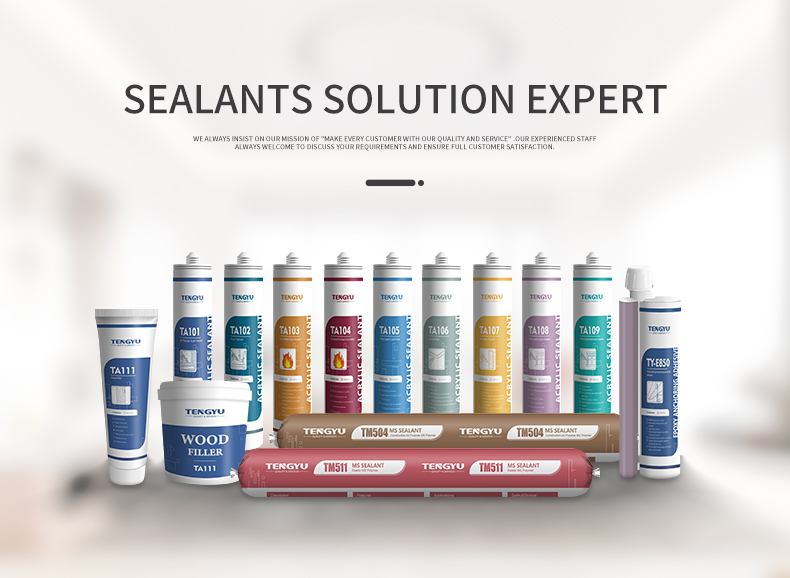
Building a house requires many different materials, all fastened to each other. Materials such as concrete, wood, metal, glass, fiberglass, etc. all have their place and use in structures. However, the joints where these different materials may meet are difficult to seal because the different materials do not always form the tightest bonds. Fortunately, there's a whole class of building products designed just for the job: sealants.
1. What is a sealant?
Sealants are substances used to seal, block, or close gaps between building materials to prevent the passage of fluids, air, and vermin. These materials seal joints where dissimilar materials meet, filling in any irregularities that may exist between the two surfaces. Sealants can also fill cracks in surfaces like concrete, fiberglass, and other rigid building materials.
Sealants usually come in thick liquid or paste form that can be squeezed into place with a caulk gun. Users can also apply the sealant with a trowel, or apply the liquid to the joints prior to assembly, allowing the sealant to naturally form a gap under pressure.
Sealants can also simply trim gaps around window and door trim, or provide a flexible bond between two surfaces. Since they prevent air and other substances from passing through the gaps, they can make a home more comfortable in all weathers.
2. Where is the sealant used?
It is common to find sealants in a variety of applications. The window and door installer will caulk around rough openings with sealant to create an airtight seal that will make the home feel more comfortable. The joints between the framing timber and the concrete foundation may also contain sealants, although in this case they are usually strips of foam.
Other applications for sealants include window glass, patching cracks in concrete foundation walls and sidewalks, around showers and tubs, and around moldings in your home. Anywhere there are small gaps through which water, air or insects can pass, a sealant can be used.
3.6 Types of Common Sealant Types
There are a variety of sealants available, each with its advantages and disadvantages. Some sealants are very special-purpose, meaning they are suitable for one application but may not be suitable for another. Others may be more general purpose oriented. For this reason, it is important to choose the best sealant for the specific task at hand.
Water-based sealants, also known as latex, are popular in the construction industry for sealing gaps between moldings, doors and windows. These sealers are easy to apply and clean up, and dry relatively quickly. Water-based sealers are also paintable. However, water-based sealers tend to shrink as they dry due to the high amount of moisture the sealant contains, so they are not suitable for wet or exterior applications.
(2) Acrylic sealant
Acrylic sealants are paintable like latex, but they tend to seal more consistently and shrink less. This makes these sealers generally paintable, making them useful for outdoor applications where color matching may be required, such as concrete cracks, trim around exterior doors and windows, and other repairs that are easily visible and exposed to the weather. However, understand that acrylic sealants are not as flexible as some other sealants, so moving over time can cause cracking.
(3) Butyl sealant
Butyl sealants are rubber based and they adhere well to many different materials. They can be a bit runny and sticky, making them difficult to apply. However, these sealants don't actually cure like other sealants, so they tend to be very flexible, long-lasting, and resistant to UV rays, moisture, and aging. They're highly water-resistant, but they're not very resistant to movement, which means these sealants can tear. They also don't take paint very well.
While polysulfide sealants are expensive and contain more volatile organic compounds (VOCs) than other types of sealants, they perform well in certain applications. They are extremely flexible throughout their service life and can even be applied underwater, making them an excellent choice for active leaks that require immediate repair. These repairs won't be temporary either -- some polysulfide sealants can last up to 20 years. Keep in mind that most polysulfide sealers don't accept paint well.
(5) Silicone sealant
In addition to being unpaintable, silicone sealants are an excellent all-around sealant choice. These products are still very flexible and highly water resistant. They are also less prone to shrinkage than most other sealants, and will adhere to almost any material. The main disadvantage of these sealants is that they are expensive, but they are most useful for creating water and air barriers.
For a tough sealer that will stick to just about everything, a polyurethane-based sealer is probably your best bet. These sealants create a strong bond between materials and seal joints to prevent the passage of fluids and other substances. They are also abrasion resistant and offer greater flexibility than many other sealant types, making them a favorite in the construction industry. Polyurethane sealants are rarely paintable, but they often come in tinted shades like gray, black, or white to match the concrete and trim.
Regardless of the application, it is important to choose the best sealant for the job. For interior applications that require painting, the affordability and paintability of water-based sealants are ideal. For a strong yet flexible bond, polyurethane may be the way to go. It depends, but rest assured there is a sealant for every application.
Prev : How to use glass silicone sealant for home decoration
Next : How do I choose a suitable alternative for silicone sealant?
Related Articles
Quality Control in Sealant & Waterproof Coating Manufacturing | From Raw Materials to Finished Products
What Is No More Nails? No More Nails vs Silicone Sealant Explained
Silicone Sealant Yellowing: How to Avoid Discoloration in Clear Caulk
What Is No More Nails? Uses, Strength & How to Apply It
Floor Adhesives: A Comparative Guide to Acrylic, MS, and Polyurethane
You May Also Like
-
top Reco Quality Control in Sealant & Waterproof Coating Ma...

-
top Reco What Is No More Nails? No More Nails vs Silicone S...
nail free glue 
-
top Reco Silicone Sealant Yellowing: How to Avoid Discolora...
silicone sealant 
-
top Reco Which sealant is more mold resistant polyurethane ...
silicone sealant acrylic sealant pu sealant 
-
Polyurethane waterproof concrete sealant Types: 1K...
construction materials Polyurethane sealant Factory & Manufacturer 
-
Custom Color Constrcution Sealants: Matching Your ...
silicone sealant acrylic sealant Ms sealant pu sealant 

 Tina
Tina Tina
Tina
