

English
- English
- Русский
TENGYU DYNAMIC
Specializing in silicone adhesive and sealant research and development, production, sales in one of the national high-tech enterprises

How long does it take for sealant to cure?
2023-10-17 08:00:00
Click:
“
Sealant is an adhesive that plays a sealing role and is a branch of adhesive. Sealant is used at the joints of various mechanical or process systems. The adhesive force (or external force) generated by it has a leak-proof sealing effect. Sealants have been widely used in the sealing of connection parts such as machinery, vehicles, aviation, shipbuilding, construction, instruments, electronic equipment and chemical systems, as well as the sealing of riveting, welding, bolts and other structural g
”
How long does it take for sealant to cure?
Sealant is a new type of polymer sealing material used for static sealing parts of mechanical products, also known as liquid gasket. It can easily fill the gaps in the joint parts of flanges, valves, elbows, joints, sockets, cylinders and threaded connections with complex joint surfaces, forming uniform, continuous and stable peelability or viscosity, The viscoelastic film prevents the leakage of fluid media and acts as a sealing gasket.
Sealant is an adhesive that plays a sealing role and is a branch of adhesive. Sealant is used at the joints of various mechanical or process systems. The adhesive force (or external force) generated by it has a leak-proof sealing effect. Sealants have been widely used in the sealing of connection parts such as machinery, vehicles, aviation, shipbuilding, construction, instruments, electronic equipment and chemical systems, as well as the sealing of riveting, welding, bolts and other structural gaps.
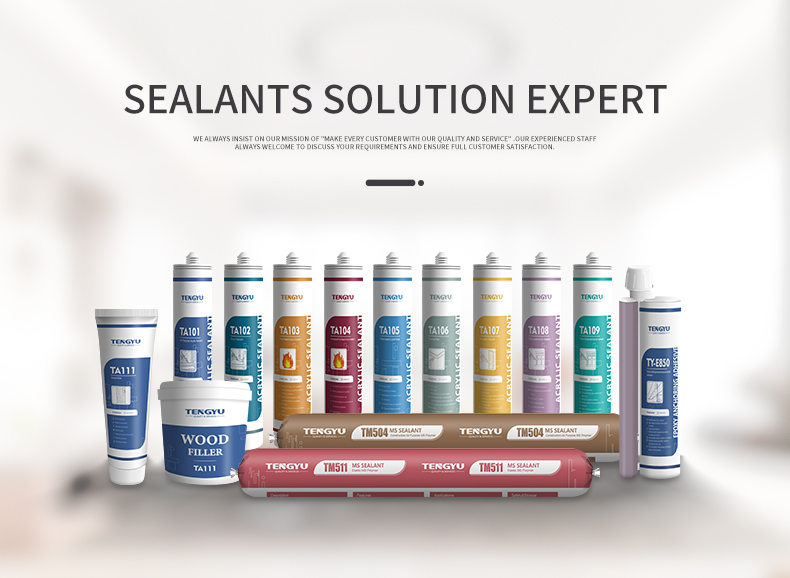
Let me explain to you how long it takes for the sealant to cure.
Generally speaking, sealant can be initially cured in 24 hours, and theoretically reaches complete curing in 7 days. All physical and electrical properties begin to cure after 7 days. Adhesive that acts as a seal. If only the surface is cured, usually 1 to 2 hours is enough. If you make a pencil-thick strip, it will take 1-2 days for the inside to completely dry. If it is a curtain wall unit construction, it is recommended to maintain it for at least 7 days after gluing. The construction standard requires 21 days of maintenance.
Precautions when using sealant:
1. In order to obtain a good sealing effect, the surface of the components to be sealed must be clean, dry, and free of impurities, oil or other stains. Try to wipe it clean with absolute alcohol or acetone.
2. Cut the tip according to the required size, squeeze the glue out of the hose, and apply glue directly for bonding. The amount of glue applied should ensure that there is sufficient contact area between the glue and both sides of the joint.
3. Leave it at room temperature for 12 to 24 hours to absorb trace amounts of water vapor in the air and solidify on its own. If the adhesive layer is thick and the bonding surface is large, the curing time will be longer, otherwise it will be shorter. The longer the bonding time is, the better the bonding effect will be. Temperature-resistant components can be cured at room temperature and placed at -50°C to 150°C, and baked for 4 to 12 hours under high humidity conditions for better bonding effects.
Prev : Four functions of door and window sealant you must know!
Next : The Difference Between Weatherproof Silicone Sealant And Structural Silicone Sealant
Related Articles
Quality Control in Sealant & Waterproof Coating Manufacturing | From Raw Materials to Finished Products
What Is No More Nails? No More Nails vs Silicone Sealant Explained
Silicone Sealant Yellowing: How to Avoid Discoloration in Clear Caulk
What Is No More Nails? Uses, Strength & How to Apply It
Floor Adhesives: A Comparative Guide to Acrylic, MS, and Polyurethane
You May Also Like
-
top Reco Quality Control in Sealant & Waterproof Coating Ma...

-
top Reco What Is No More Nails? No More Nails vs Silicone S...
nail free glue 
-
top Reco Silicone Sealant Yellowing: How to Avoid Discolora...
silicone sealant 
-
top Reco Which sealant is more mold resistant polyurethane ...
silicone sealant acrylic sealant pu sealant 
-
Hydrophilic Waterstop Polyurethane Sealant for Con...

-
MS Polymer Wood Flooring Adhesive: Product Selecti...

 Tina
Tina Tina
Tina
