

English
- English
- Русский
TENGYU DYNAMIC
Specializing in silicone adhesive and sealant research and development, production, sales in one of the national high-tech enterprises

What are the common problems with silicone sealants?
2023-12-14 09:06:46
Click:
“
What are the reasons for the failure of the bonding between the silicone sealant and the substrate, resulting in cracks, bulges, and bubbles?
”
1. What are the causes of bonding failure between silicone sealant and substrate?
We need to analyze the bonding failure from the following aspects: (1) Check whether the silicone sealant has been tested for adhesion to the base material in advance; (2) Whether the base material is cleaned in place; (3) Maintenance after application Whether the time meets the requirements, the curing time needs to be extended at low temperatures; (4) When primer needs to be applied on site, whether the primer is appropriate; (5) Whether the gluing operation is performed under extreme conditions.
2. What solutions are there for the application of various plastics, such as PMMA (acrylic), PC (polycarbonate), PVC and other plastics in construction?
Since release agents are used in the plastic production process and are easily swollen and damaged by chemical solvents, the surface active energy is low and it is not easy to bond. When sealant is required, it is necessary to consider the adhesion of the sealant to the substrate and not cause corrosion to the plastic. Sibao 1086 high-performance waterproof and weather-resistant sealant is a new waterproof and weather-resistant sealant for various plastic bonding applications. It can effectively solve the bonding problems of metal, glass, various PMMA, PC, PVC and other materials.
3. We often encounter the problem of sealant cracking during projects. What causes it?
There are many reasons for cracking of sealants on projects, mainly the following reasons: (1) Organic sealants such as polysulfide rubber and polyurethane sealant are not resistant to aging and cracking; (2) Inferior silicone sealants harden and crack on their own; (3) If the sealant is too thick or too thin during application, it will easily crack due to stress; (4) The three-sided bonding of the displacement joint will also easily crack; (5) Improper selection of sealant, weather-resistant sealant has 20 levels according to the standard , 25-level, 35-level, 50-level, 100/50-level and other models. However, the actual engineering joint displacement is greater than the displacement capacity of the sealant, resulting in cracking. To deal with the cracking problem, we need to choose good quality silicone weather-resistant sealant, and controlling the width-to-thickness ratio and sealant thickness during on-site construction can effectively avoid the problem of sealant cracking on the project.

4. What are the reasons for irregular blistering on the surface of on-site weather-resistant adhesive? How to deal with it?
The main causes of blistering problems are as follows: (1) Environmental reasons: ① When the sealant is injected, the joints are moist and the foam rods and other accessories are damp, which makes blistering more likely; ② When the surface temperature of the base material is too high during the sealant application, it will Causes sealant bubbles; (2) Reasons for manual operation: ① Discontinuity or the moving speed of the sealant gun is inconsistent with the sealant dispensing speed, resulting in uneven sealant application, which is easy to entrap some air and form hollow bubbles; ② Improper construction, resulting in closed The surface of the porous foam rod ruptures and the foam rod releases gas.
Treatment methods: (1) Carry out construction according to the requirements in the "Guidelines for the Use of Silicone Sealants" and avoid applying sealant in environments such as moisture and high temperature exposure; (2) Uniformly standardize the operation of sealant applicators; (3) Use appropriate For foam rods, it is recommended that the diameter of the foam rod be about 120% of the width of the sealant gap.
5. What are the causes of irregular wrinkles and bulging on the surface of on-site weather-resistant adhesive? How to deal with it?
The bulging phenomenon mainly occurs on metal panel curtain walls, such as aluminum panel curtain walls. Due to the high thermal expansion and contraction coefficient of aluminum panels, the temperature difference between day and night is too large during the seasonal alternation period, and the sealant cannot fully adapt to the larger temperature before it is fully cured. Due to the displacement, the sealant will bulge irregularly due to the tensile and compression of the aluminum plate.
Treatment method: (1) When applying sealant to aluminum plate and aluminum-plastic plate curtain wall projects, please avoid the peak period of heat accumulation. Construction should be done after 17:00 on the west and southeast sides. And when the surface temperature of the base material is lower than 4°C or higher than 50°C, it is not suitable for construction; (2) It is recommended to apply the sealant in two times. The thickness of the first sealant should be controlled at about half the depth of the gap, and the next day (the specific time depends on the (depending on the curing degree of the colloid) and then apply a second coat of sealant; (3) It is recommended to choose Sibao 998 silicone weather-resistant sealant (quick-setting type), which can significantly improve the bulging phenomenon.
Related Articles
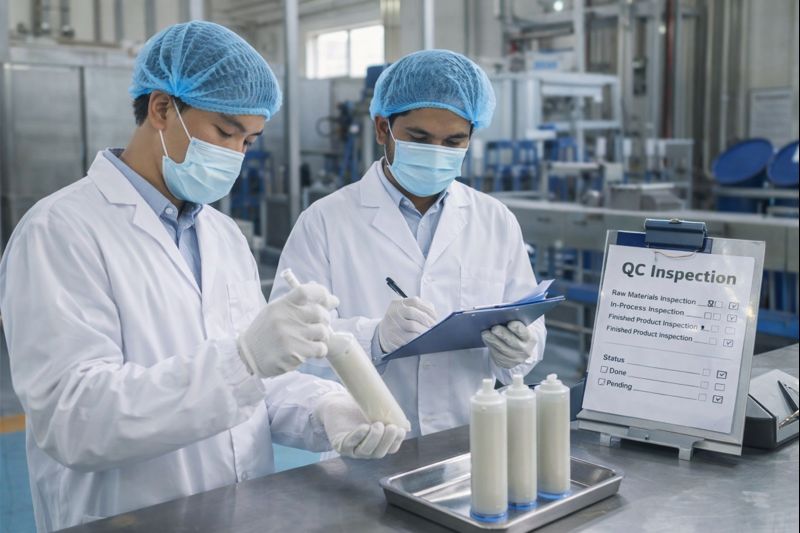
Quality Control in Sealant & Waterproof Coating Manufacturing | From Raw Materials to Finished Products
What Is No More Nails? No More Nails vs Silicone Sealant Explained
Silicone Sealant Yellowing: How to Avoid Discoloration in Clear Caulk
What Is No More Nails? Uses, Strength & How to Apply It
Floor Adhesives: A Comparative Guide to Acrylic, MS, and Polyurethane
You May Also Like
-
top Reco Quality Control in Sealant & Waterproof Coating Ma...

-
top Reco What Is No More Nails? No More Nails vs Silicone S...
nail free glue 
-
top Reco Silicone Sealant Yellowing: How to Avoid Discolora...
silicone sealant 
-
top Reco Which sealant is more mold resistant polyurethane ...
silicone sealant acrylic sealant pu sealant 
-
MS Polymer Wood Flooring Adhesive: Product Selecti...

-
Polyurethane waterproof concrete sealant Types: 1K...
construction materials Polyurethane sealant Factory & Manufacturer 
 Tina
Tina Tina
Tina
