

English
- English
- Русский
TENGYU DYNAMIC
Specializing in silicone adhesive and sealant research and development, production, sales in one of the national high-tech enterprises

How to use and precautions for anaerobic adhesives
2024-01-03 09:41:05
Click:
“
Anaerobic adhesives, also known as anaerobic adhesives, anaerobic adhesives, thread adhesives, and mechanical adhesives, are also known as "anaerobic locking (tightening) agents" abroad. They are a new type of sealing adhesive.
”
Anaerobic adhesive, referred to as anaerobic adhesive, is a single-component sealing adhesive made by utilizing the principle of oxygen radical inhibition of free radical polymerization. It can be used for both bonding and sealing. When the coating surface is isolated from the air and catalyzed, it can rapidly polymerize and solidify at room temperature. The composition of anaerobic adhesives is relatively complex, with unsaturated monomers as the main components, and aromatic amines, phenols, aromatic hydrazines, peroxides, etc. In recent years, the formulas of foreign anaerobic adhesives have been continuously introduced and improved day by day, and are favored by the machinery industry.
How to use anaerobic adhesive:
(1) Surface treatment
Clean the adhered surface, remove oil and rust, polish appropriately, and keep it clean and dry. Activate inert, non-metallic surfaces with accelerators. The surface cleanliness of the adherend is very important, and the gas phase degreasing effect is the best. Commonly used solvents include trichloroethane, trichlorethylene, methyl ethyl ketone, methanol, etc. It is not advisable to use gasoline, kerosene, naphtha, fuel oil, hydrocarbon solvents, etc., because they will leave an oil film on the surface. The common degreasing method is to clean twice with solvent gasoline. Proper polishing of the surface of the adherend will help improve the bonding strength. The surface roughness is preferably 0.76μm~2μm. If it is larger than 3.2μm, the gap will be too large and the bonding strength will be reduced. For the bonding of non-metallic surfaces, accelerator should be applied. It is better to apply accelerator on one side, and then apply sealant after drying for 3 to 5 minutes.
(2) sealant
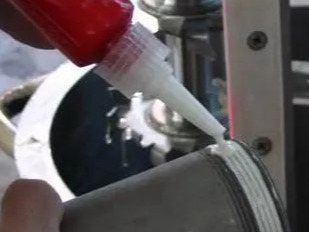
The anaerobic adhesive can be applied directly to the adhered surface in the original packaging, or it can be applied by brushing or scraping. The best results are achieved when the surfaces of both adherends are coated with sealant. Satisfactory results can be achieved by coating one surface and then assembling it. For bolts, the sealant can only be applied to the bolt end and thread opening. When tightened, the sealant will fill the entire gap. If there are cracks or parts that are inconvenient to disassemble, sealant penetration can also be used. It is advisable to apply sealant to fill the gap. The optimal thickness of the sealant layer is 0.03mm~0.075mm. Excessive thickness will reduce the strength.
(3) Assembly
During assembly, the parts should be rotated back and forth to spread the sealant, and the parts should be positioned as quickly as possible. If an accelerator is used, the position can only be adjusted within the allowed time (1min~5min).
Assembled parts are generally partially cured at room temperature. In general, the larger the bonding area, the smaller the gap, and the faster the curing. After curing for 3 hours, the bonding strength can reach 50%~65% of the rated value, and can reach the maximum value in 24 hours. As the temperature increases, the curing time shortens and the bonding strength increases. The newly developed fast-curing anaerobic adhesive can be positioned within seconds to minutes, and the shear strength can reach more than 80% of the maximum value after 15 minutes.
Related Articles
Quality Control in Sealant & Waterproof Coating Manufacturing | From Raw Materials to Finished Products
What Is No More Nails? No More Nails vs Silicone Sealant Explained
Silicone Sealant Yellowing: How to Avoid Discoloration in Clear Caulk
What Is No More Nails? Uses, Strength & How to Apply It
Floor Adhesives: A Comparative Guide to Acrylic, MS, and Polyurethane
You May Also Like
-
top Reco Quality Control in Sealant & Waterproof Coating Ma...

-
top Reco What Is No More Nails? No More Nails vs Silicone S...
nail free glue 
-
top Reco Silicone Sealant Yellowing: How to Avoid Discolora...
silicone sealant 
-
top Reco Which sealant is more mold resistant polyurethane ...
silicone sealant acrylic sealant pu sealant 
-
MS Polymer Wood Flooring Adhesive: Product Selecti...

-
Polyurethane waterproof concrete sealant Types: 1K...
construction materials Polyurethane sealant Factory & Manufacturer 
 Tina
Tina Tina
Tina
