

English
- English
- Русский
TENGYU DYNAMIC
Specializing in silicone adhesive and sealant research and development, production, sales in one of the national high-tech enterprises

Do you know about silicone sealant for stone curtain walls?
2024-03-19 13:57:24
Click:
“
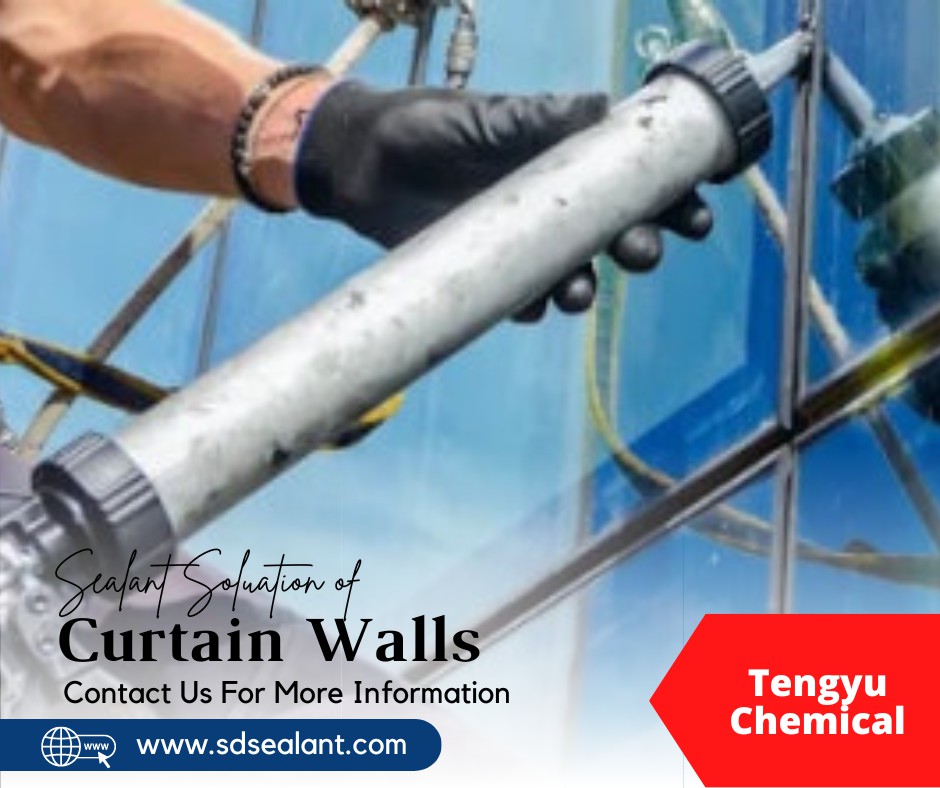
Construction sealant (weather-resistant sealant) is one of the main materials of stone curtain walls. It is mainly used to seal the gaps on the surface of stone curtain walls to prevent rainwater leakage and air penetration.
”
The technical performance requirements of silicone weather-resistant sealant for stone curtain walls are as follows:
1. Tensile strength.
That is the tensile resistance of the sealant itself.
2. Tear strength.
That is, the ability to resist tearing along the sealant layer itself.
3. Peel strength.
That is, the adhesion ability between the sealant and the base material (stone).
Peel strength is a major indicator for evaluating the performance of a sealant. It should satisfy the repeated stretching and compression of the sealant joint due to temperature changes, and maintain good bonding between the sealant and the base material.
4. Elastic modulus.
It represents the relationship between stress and strain of the adhesive.
Silicone weather-resistant sealants for stone curtain walls can be divided into two types: high modulus and medium modulus. Under the same stress condition, high-modulus sealants produce smaller strains than medium-modulus sealants, and larger strains will cause adhesive failure under boundary conditions. Silicone stone sealant is a medium-modulus sealant that does not harden or increase its elastic modulus under low temperature conditions. Therefore, it will not lose its adhesion to the substrate after repeated stretching and compression.
5. Elastic recovery ability.
That is, under the action of external force, the sealant is stretched and compressed and then returns to its original size and maintains its adhesion properties.
If the elastic recovery ability of the silicone weather-resistant sealant used for stone curtain walls is poor, stress relaxation will occur inside the sealant and plastic deformation will occur. This will produce higher internal stress when it is stretched and compressed again, leading to adhesion failure.
6. Displacement tolerance.
That is, the sealant joints will cause the sealant joints to stretch, compress, or move under the influence of temperature changes, wind loads, and earthquakes. In order to maintain a good seal, the sealant should have a certain displacement tolerance, which is the so-called displacement ability.
7. Hardness.
The hardness of silicone weather-resistant sealant for stone curtain walls is generally tested using the rubber Shore A hardness test method (ShoreA). The hardness of the seal is required to not harden at low temperatures and not soften at high temperatures.
8. Non-polluting.
Stone silicone sealant should ensure that there is no oil leakage or other pollution to the stone. In terms of stone structure, stone is porous. If a non-specific stone sealant is used, oil marks will appear on the edge of the sealant joint, which is oil seepage. This will affect the decorative effect of the stone. Therefore, stone silicone sealants are required to have anti-pollution properties.
9. Selection and use of silicone weather-resistant sealant for stone curtain walls.
The stone silicone sealant selected in the project should have sufficient tensile strength, bonding strength, tear strength and tensile-compression cycle fatigue performance, and should It is resistant to ultraviolet rays, aging, water and climate change, and should have good compatibility and stable adhesion with the base material (i.e. stone). When the compatibility of sealant and stone cannot be determined, a compatibility test should be conducted in a specialized testing department.
Related Articles
Quality Control in Sealant & Waterproof Coating Manufacturing | From Raw Materials to Finished Products
What Is No More Nails? No More Nails vs Silicone Sealant Explained
Silicone Sealant Yellowing: How to Avoid Discoloration in Clear Caulk
What Is No More Nails? Uses, Strength & How to Apply It
Floor Adhesives: A Comparative Guide to Acrylic, MS, and Polyurethane
You May Also Like
-
top Reco Quality Control in Sealant & Waterproof Coating Ma...

-
top Reco What Is No More Nails? No More Nails vs Silicone S...
nail free glue 
-
top Reco Silicone Sealant Yellowing: How to Avoid Discolora...
silicone sealant 
-
top Reco Which sealant is more mold resistant polyurethane ...
silicone sealant acrylic sealant pu sealant 
-
MS Polymer Wood Flooring Adhesive: Product Selecti...

-
Polyurethane waterproof concrete sealant Types: 1K...
construction materials Polyurethane sealant Factory & Manufacturer 
 Tina
Tina Tina
Tina
