

English
- English
- Русский
TENGYU DYNAMIC
Specializing in silicone adhesive and sealant research and development, production, sales in one of the national high-tech enterprises

What is water swelling polyurethane sealant?
2024-09-07 10:17:38
Click:
“
Polyurethane sealant is a kind of glue that is widely used nowadays. It can bond well with metal, concrete, glass, etc. and has a very long service life. If it is not exposed to sunlight for a long time, the service life can be as long as 20 years. In addition, polyurethane sealant has good weather resistance and is environmentally friendly and non-toxic. It can be used safely both indoors and outdoors. Today I will introduce a water swelling polyurethane sealant
”
Water-swelling polyurethane sealant not only has the advantages of traditional polyurethane sealants, but also has the performance of water-swelling. Water-swelling polyurethane sealant can generally be divided into two types: PJ220 and PJ400. The main difference is the increased water-swelling ratio and water pressure resistance. The water-swelling ratio of PJ220 is more than 2.2 times, and the water pressure resistance is 1.5MPa. The water-swelling ratio of PJ400 is more than 4 times, and the water pressure resistance is 2.5MPa.
The synthesis of water-swelling polyurethane sealant is based on polyurethane prepolymer, combined with urethane paste containing special grafting technology, and has dual water-stopping properties of elastic sealing and water-swelling polyurethane sealant. Because it contains urethane connecting chains with special grafting technology, it will not cause the loss of water-swelling elements in long-term use, thus greatly increasing its service life. Water-swelling polyurethane sealant can be constructed in humid environments and has good acid and alkali corrosion resistance. Hydrochloric acid, seawater, sodium hydroxide and other media will not cause the water-swelling polyurethane sealant to lose its function.
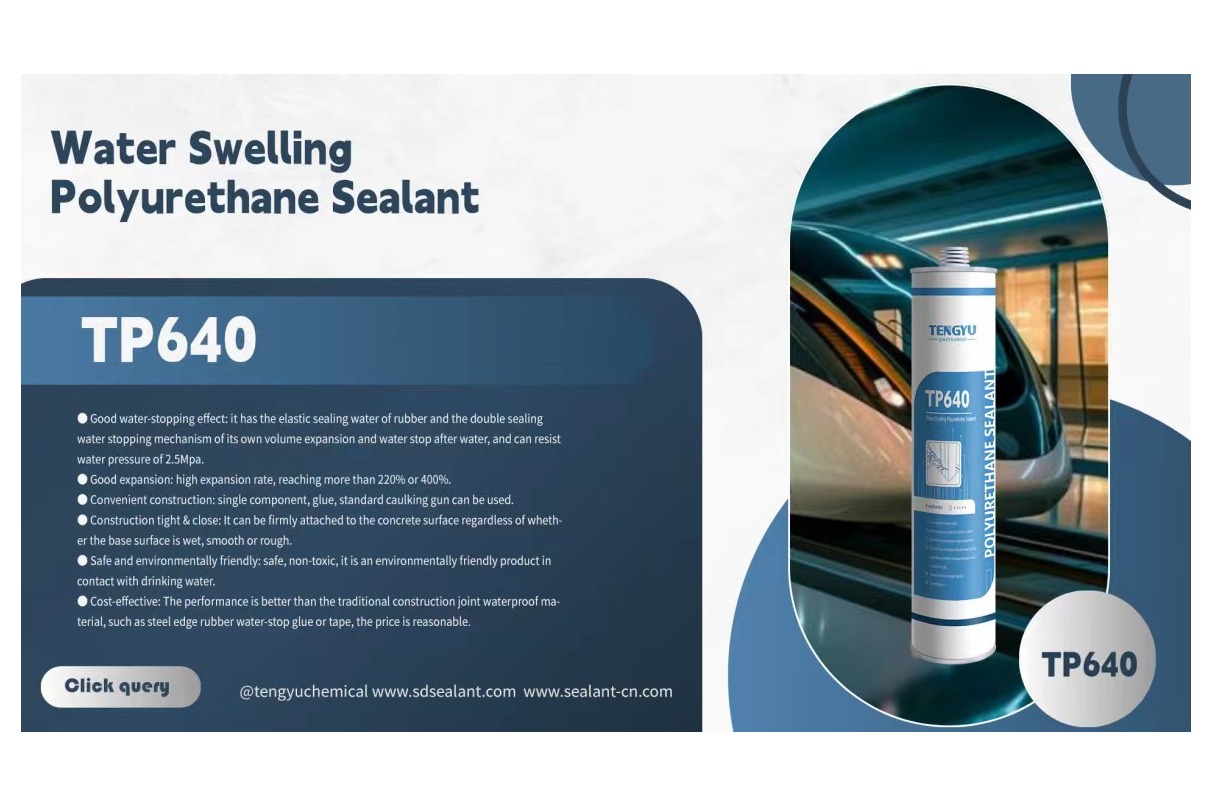
Water-swelling polyurethane sealant can be widely used in subway tunnels, highway and railway tunnels, sewage pools and other fields. In view of its good environmental performance, it can be directly used in direct drinking water projects such as water plants and reservoirs. The construction of polyurethane sealant is relatively simple. The first step is to clean the construction joints. Just clean up the more obvious dust and concrete particles. There are no strict requirements for the dry and wet conditions. There is no obvious water. Then install the glue gun to apply glue. It should be noted that the size of the glue nozzle opening should be cut according to the size of the gap. If it is too large, it will cause waste, and if it is too small, it will not be able to block the gap well. The last step is to apply glue. Apply the glue into the construction joint. If it is for home use, you need to stick seam paper on both sides of the gap and peel it off after applying the glue. After the glue is applied into the construction joint, it should be avoided from contact with water before it solidifies.
Prev : What are the performance characteristics of silicone structural sealant
Next : Do you know the common sense of silicone sealant? (Part 1)
Related Articles
Quality Control in Sealant & Waterproof Coating Manufacturing | From Raw Materials to Finished Products
What Is No More Nails? No More Nails vs Silicone Sealant Explained
Silicone Sealant Yellowing: How to Avoid Discoloration in Clear Caulk
What Is No More Nails? Uses, Strength & How to Apply It
Floor Adhesives: A Comparative Guide to Acrylic, MS, and Polyurethane
You May Also Like
-
top Reco Quality Control in Sealant & Waterproof Coating Ma...

-
top Reco What Is No More Nails? No More Nails vs Silicone S...
nail free glue 
-
top Reco Silicone Sealant Yellowing: How to Avoid Discolora...
silicone sealant 
-
top Reco Which sealant is more mold resistant polyurethane ...
silicone sealant acrylic sealant pu sealant 
-
Hydrophilic Waterstop Polyurethane Sealant for Con...

-
MS Polymer Wood Flooring Adhesive: Product Selecti...

 Tina
Tina Tina
Tina
