

English
- English
- Русский
TENGYU DYNAMIC
Specializing in silicone adhesive and sealant research and development, production, sales in one of the national high-tech enterprises

What OEM Buyers Should Ask Before Ordering Private Label Sealants
2026-01-14 16:21:13
Click:
“
What OEM buyers and distributors should ask before ordering private label sealants. Learn about factory capability, quality control, formulation, and OEM risks.
”
Private label sealants offer OEM buyers a fast and flexible way to build their own brand and expand product lines. However, choosing the wrong supplier can result in inconsistent quality, unstable supply, and long-term brand risk.
Before placing an OEM or private label sealant order, buyers should carefully evaluate the manufacturer’s technical capability, quality control system, and cooperation model.
Below are the key questions every OEM buyer should ask to ensure a successful and sustainable partnership.
1. Are You a Manufacturer or a Trading Company?
This is the first and most important question.
A true sealant manufacturer should be able to clearly explain:
- Where the products are produced
- What production lines are available
- Whether formulation and filling are done in-house
- How quality is controlled during production
Working directly with a manufacturer provides better cost control, more stable quality, and faster technical response compared to trading companies.
2. Can You Customize Formulations Based on Market Requirements?
Different markets and applications require different sealant performance.
OEM buyers should confirm whether the supplier can adjust:
- Curing system (neutral cure, acetoxy, etc.)
- Adhesion to specific substrates
- Elasticity and movement capability
- Weather resistance and durability
A qualified OEM manufacturer should not only copy existing products, but also support formulation optimization based on local standards and application needs.
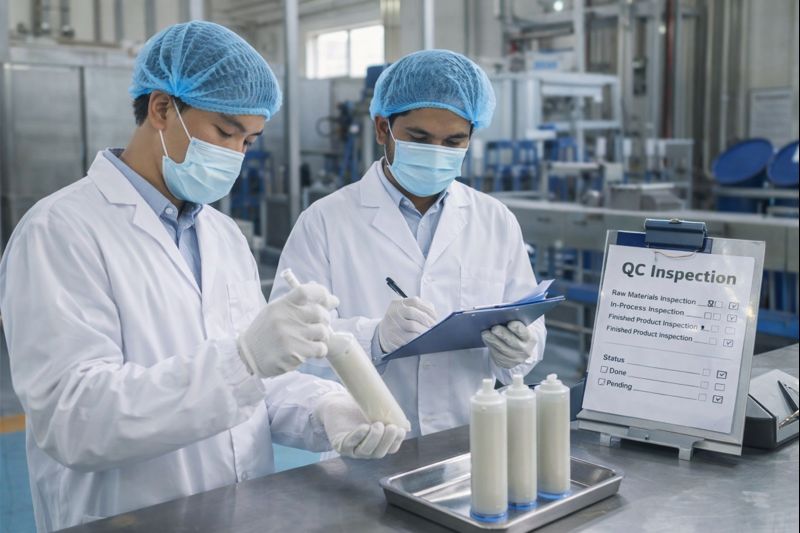
3. What Quality Control Procedures Are in Place?
Quality consistency is critical for private label brands.
OEM buyers should ask about the supplier’s quality control workflow, including:
- Raw material inspection before production
- In-process quality monitoring
- Pre-filling performance checks
- Finished product inspection
- Batch sample retention and traceability
A systematic QC process ensures stable performance across batches and reduces after-sales risks for OEM brands.
4. Can You Provide Test Reports and Support Third-Party Inspection?
Reliable OEM partners should be transparent about product testing.
Key points to confirm include:
- Availability of internal test reports
- Support for third-party inspection upon request
- Ability to provide documentation for market entry
This is especially important for distributors supplying construction projects or regulated markets.
5. What Is the Minimum Order Quantity (MOQ) for Private Label Orders?
MOQ directly affects inventory pressure and cash flow.
OEM buyers should clearly understand:
- MOQ for customized packaging
- MOQ for formulation customization
- Differences between standard and customized products
Flexible MOQ policies indicate that the manufacturer has mature production planning and experience with OEM customers.
6. What Private Label Options Are Available?
Private label cooperation is not limited to putting a logo on the cartridge.
Buyers should ask whether the supplier supports:
- Customized cartridge and sausage printing
- Carton and packaging design
- Language localization
- Label compliance for different markets
Comprehensive private label support helps OEM buyers build a professional and competitive brand image.
7. How Stable Is the Production Capacity and Lead Time?
Unstable delivery can seriously affect OEM customers’ sales plans.
Important questions include:
- Monthly or annual production capacity
- Typical lead time for OEM orders
- Ability to handle repeat and large-volume orders
A factory with stable capacity and clear scheduling is better suited for long-term OEM cooperation.
8. How Do You Handle Quality Claims and After-Sales Support?
Even with strict quality control, professional after-sales handling is essential.
OEM buyers should understand:
- How quality issues are investigated
- Whether batch traceability is available
- Technical support response time
A responsible manufacturer should provide clear procedures rather than vague promises.
Why Choosing the Right OEM Sealant Manufacturer Matters
Private label sealants directly represent your brand in the market.
The right manufacturing partner helps you:
- Maintain consistent product performance
- Reduce quality risks and customer complaints
- Build long-term brand credibility
- Scale your business with confidence
OEM cooperation should be a strategic partnership, not just a one-time transaction.
Partner with a Reliable Private Label Sealant Manufacturer
As an experienced sealant and waterproof coating manufacturer, we support OEM buyers with:
- In-house formulation and production
- Strict quality control procedures
- Flexible private label solutions
- Stable supply for long-term cooperation
If you are planning to launch or expand your private label sealant products, our team is ready to support your OEM project.
Request OEM Consultation
Get Private Label Quotation
Contact Person: Tina
Phone No.: 0086-18596167593
WhatsApp: 0086-18596167593
EMAIL:tina@sdsealant.com
Related Articles
Quality Control in Sealant & Waterproof Coating Manufacturing | From Raw Materials to Finished Products
What Is No More Nails? No More Nails vs Silicone Sealant Explained
Silicone Sealant Yellowing: How to Avoid Discoloration in Clear Caulk
What Is No More Nails? Uses, Strength & How to Apply It
Floor Adhesives: A Comparative Guide to Acrylic, MS, and Polyurethane
You May Also Like
-
top Reco Quality Control in Sealant & Waterproof Coating Ma...

-
top Reco What Is No More Nails? No More Nails vs Silicone S...
nail free glue 
-
top Reco Silicone Sealant Yellowing: How to Avoid Discolora...
silicone sealant 
-
top Reco Which sealant is more mold resistant polyurethane ...
silicone sealant acrylic sealant pu sealant 
-
Hydrophilic Waterstop Polyurethane Sealant for Con...

-
MS Polymer Wood Flooring Adhesive: Product Selecti...

 Tina
Tina Tina
Tina
