

English
- English
- Русский
TENGYU DYNAMIC
Specializing in silicone adhesive and sealant research and development, production, sales in one of the national high-tech enterprises

How to choose building sealant?
2023-03-20 10:51:02
Click:
“
How to choose sealant is the key, according to the performance characteristics of the selection.
”
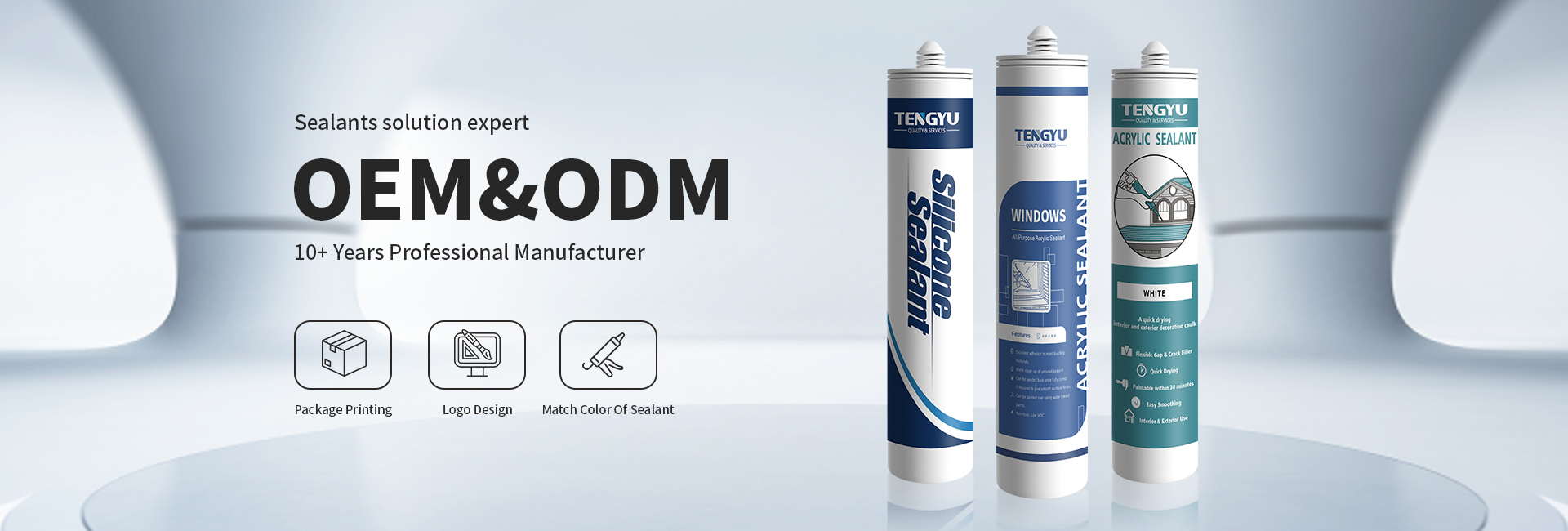
With the continuous update of building construction technology, the choice of building sealant is more and more important, among them, the correct choice of professional and targeted building sealant, and control of its construction quality is particularly important.There are many types of building sealant, including silicone, polyurethane, polysulfide, acrylic acid, butyl, asphalt and oil resin modified products.
1.Selection of building sealant
-Bonding of concrete
The PC board used on the market is mostly concrete board, so the building sealant should have good adhesion to concrete. Due to the characteristics of concrete itself, ordinary sealant is not easy to bond on its surface. The selection of building sealant should consider that concrete is an alkaline porous material, and whether the release agent used in the release of the PC board surface remains.
-Displacement of joint
When choosing sealant, its mechanical properties are also very important. The displacement of the joint should be considered in the design, and the width of the joint should be determined so that the deformation of the sealant is within the maximum allowable range. For the concrete joint of 10~35mm, the sealant is generally required to have good displacement capacity and elastic recovery rate to adapt to the joint displacement.
-Weather fastness
The weather resistance of building sealant will affect its service life, and because of the specific molecular structure of silicone sealant, even in the highest energy ultraviolet irradiation is not enough to destroy its structure, to ensure that the silicone sealant has good UV resistance, so that it has obvious advantages in weather resistance.
- 2.Construction technology of building sealant
-Test before construction
Building sealant should be carried out before the construction of bonding performance test and compatibility test, to avoid the discovery after construction, due to cutting, rework and other work, delay the construction period, resulting in the waste of materials and labor. Among them, the bond performance test is to check whether the silicone rubber and the substrate can form a good bond; The compatibility test is to check whether the materials used in the construction will have adverse effects on the sealant and affect its life.
-Construction Process
Prepare the joint → Clean the bonded base surface → (if necessary, brush the bottom coating solution) → glue injection and bonding → trim the glue injection surface, remove the protective tape → curing and curing (3~5d in summer, 5~7d in winter)
3.Common Problems
-Not bonded to the substrate
The main reasons are that the bonding test was not carried out before construction, the curing temperature was too low, and the relative humidity was too high. During construction, the curing temperature should be increased, the curing time should be extended, the surface treatment of the substrate or the replacement of the sealant.
-Slow curing speed
The main reasons are low ambient temperature, low humidity, too narrow and too deep glue seam, and expired sealant. During the construction, the curing temperature and humidity should be increased, the glue or double-sided glue should be used twice, and the sealant should be replaced.
-Generate bubble
The main reason is the injection of air, moisture into the glue seam, substrate and some sealant reaction. During construction, glue should be injected evenly, continuously and filled with interface, and interface and accessory materials should be dry.
-Bulge
The main reasons are the joint deformation caused by the large plate size and the large expansion coefficient, the large plate temperature difference between day and night, and the low environmental humidity. During construction, sealant with relatively fast curing speed should be selected, and appropriate shading measures should be used to reduce the temperature of the panel.
-Cracks and leaks
The main reason is that the joint is too narrow, the seal is not in place, the sealant displacement capacity is insufficient, and the sizing thickness is too thin. During construction, the joints should be designed according to the requirements of the specification, the sealant with good displacement capacity should be selected, and the construction should be carried out according to the operation specification to ensure the thickness of the sealant and avoid trilateral bonding.
4.Matters and attention
-Thoroughly remove all loose particles and dust to ensure that the construction surface is clean, dry, and free of grease and surface dirt such as release agent, curing film, hydrophobic agent, etc.
-In order to prevent the expansion of the joint will damage the sealing adhesive, the joint should be inserted into the appropriate backing material, and the width of the backing material should be greater than 25% of the width of the joint to control the sizing thickness of the sealant.
-An oblique opening should be cut at the outer mouth of the sealing paste tank, and then a squeeze gun is installed to squeeze the sealing paste into the joint pressure surface, and the thickness and width of the sealing paste should be uniform and consistent, in line with the sealing requirements.
-When used as an adhesive, it should be sealed with point or bead surface construction, and after sealing is completed, apply 20% detergent aqueous solution to wipe the joint surface.
-After the construction is completed, sampling inspection should be carried out at the construction site to ensure good bonding and no adverse reactions.
Related Articles
Quality Control in Sealant & Waterproof Coating Manufacturing | From Raw Materials to Finished Products
What Is No More Nails? No More Nails vs Silicone Sealant Explained
Silicone Sealant Yellowing: How to Avoid Discoloration in Clear Caulk
What Is No More Nails? Uses, Strength & How to Apply It
Floor Adhesives: A Comparative Guide to Acrylic, MS, and Polyurethane
You May Also Like
-
top Reco Quality Control in Sealant & Waterproof Coating Ma...

-
top Reco What Is No More Nails? No More Nails vs Silicone S...
nail free glue 
-
top Reco Silicone Sealant Yellowing: How to Avoid Discolora...
silicone sealant 
-
top Reco Which sealant is more mold resistant polyurethane ...
silicone sealant acrylic sealant pu sealant 
-
MS Polymer Wood Flooring Adhesive: Product Selecti...

-
Polyurethane waterproof concrete sealant Types: 1K...
construction materials Polyurethane sealant Factory & Manufacturer 
 Tina
Tina Tina
Tina
