

English
- English
- Русский
TENGYU DYNAMIC
Specializing in silicone adhesive and sealant research and development, production, sales in one of the national high-tech enterprises

How to apply ms polymer wood flooring adhesive?
2024-09-25 15:46:50
Click:
“
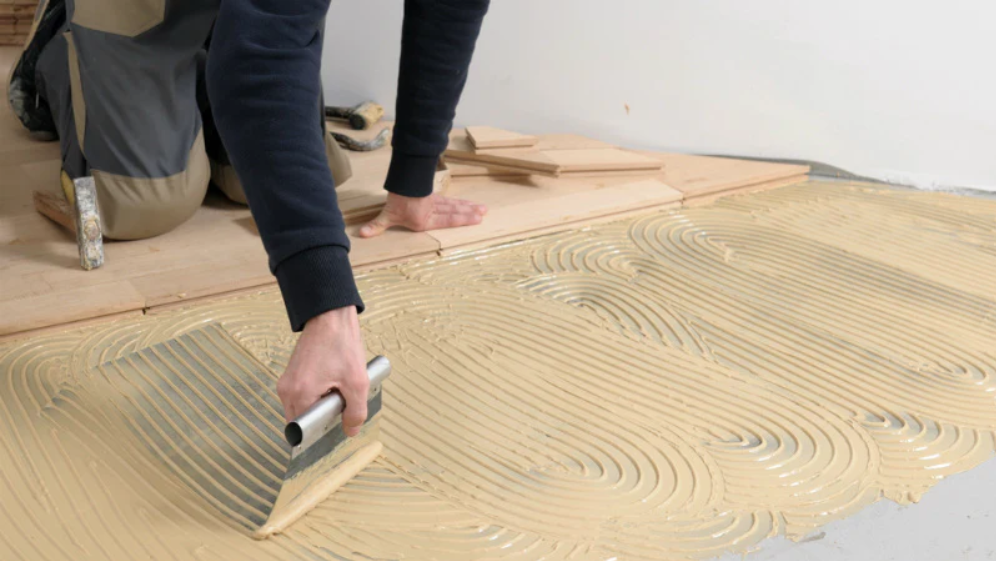
Full adhesive flooring means evenly scraping the floor adhesive on the leveled cement floor, and then directly laying the floor in a straight-through, herringbone or herringbone manner.
”
Full adhesive flooring means evenly scraping the floor adhesive on the leveled cement floor, and then directly laying the floor in a straight-through, herringbone or herringbone manner.
1. Firm bonding
The floor adhesive firmly bonds the wooden floor to the ground. When the materials between the wooden floor and the floor adhesive are compatible, the stress distribution is even, which can buffer the unidirectional expansion of the floor and ensure that the wooden floor is not easily deformed due to shrinkage and swelling.
2. Waterproof and moisture-proof
Evenly scraped on the installation surface, the floor adhesive will form a waterproof barrier on the concrete base, which helps prevent the floor from getting damp. In most cases, there is no need to apply primer or use an additional moisture-proof film.
3. Applicable to floor heating system
The floor adhesive is suitable for floor heating system, and the colloid can maintain strong bonding activity within the temperature range of -40°C~90°C.
4. Sound absorption and noise reduction
The elastic connection is formed, which reduces the shear stress between the wooden floor and the base layer, thereby compensating for the expansion and contraction of the wood. Elastic colloids can suppress the sound source and effectively reduce noise, reduce the penetration of sound waves into the building envelope, and ensure the best gait sound insulation.
5. Extremely low VOC and zero formaldehyde
Grassroots processing
1. Substrate preparation
The substrate can be concrete, tile, marble, wooden keel, or rough floor. It must be firm and flat, dry, dust-free, and free of peeling and sand. Remove any pollutants that may affect adhesion (such as dust, dirt, wax, laitance, paint, grease, and other harmful materials), and then use a vacuum cleaner to clean the dust.
2. Flatness
Use a 2-meter-long ruler to check the flatness of the ground. The chord height between the ruler and the ground should be ≤3mm. If the ground flatness does not meet the standard and paving is carried out, it will cause floor collapse, warping, arching, abnormal noise, and other problems. Unevenness can be achieved through cement-based self-leveling or local repair.
3. Moisture content
The indoor temperature for adhesive floor construction is >10℃, and the relative humidity (RH%) is between 35~80%. The moisture content of the ground should be less than 10%. If it is greater than the standard value, heating, ventilation and dehumidification treatment should be performed.
The floor heating environment should be constructed 2-3 weeks after heating. The base layer should be gradually heated in advance, and the heating should be stopped 48 hours before the start of construction. If there is primer construction, it needs to be completed and wait for 1 week before gradually heating.
How to fully spread the adhesive on the floor:
1. Open the package
Cut the package or open the packaging barrel, and squeeze the adhesive on the ground.
2. Scrape with a scraper
Use a scraper to evenly scrape the adhesive.
3. Lay the floor
Lay the floor. After the paving is completed, please press the laid floor with a heavy object.
Prev : What are the curing time and influencing factors of polyurethane sealant?
Next : What are the salient features of silicone waterproof coatings for roofs:
Related Articles
Quality Control in Sealant & Waterproof Coating Manufacturing | From Raw Materials to Finished Products
What Is No More Nails? No More Nails vs Silicone Sealant Explained
Silicone Sealant Yellowing: How to Avoid Discoloration in Clear Caulk
What Is No More Nails? Uses, Strength & How to Apply It
Floor Adhesives: A Comparative Guide to Acrylic, MS, and Polyurethane
You May Also Like
-
top Reco Quality Control in Sealant & Waterproof Coating Ma...

-
top Reco What Is No More Nails? No More Nails vs Silicone S...
nail free glue 
-
top Reco Silicone Sealant Yellowing: How to Avoid Discolora...
silicone sealant 
-
top Reco Which sealant is more mold resistant polyurethane ...
silicone sealant acrylic sealant pu sealant 
-
MS Polymer Wood Flooring Adhesive: Product Selecti...

-
Polyurethane waterproof concrete sealant Types: 1K...
construction materials Polyurethane sealant Factory & Manufacturer 
 Tina
Tina Tina
Tina
