

English
- English
- Русский
TENGYU DYNAMIC
Specializing in silicone adhesive and sealant research and development, production, sales in one of the national high-tech enterprises

The Essential Role of Sealants in Window and Door Installation
2025-07-04 00:00:00
Click:
“
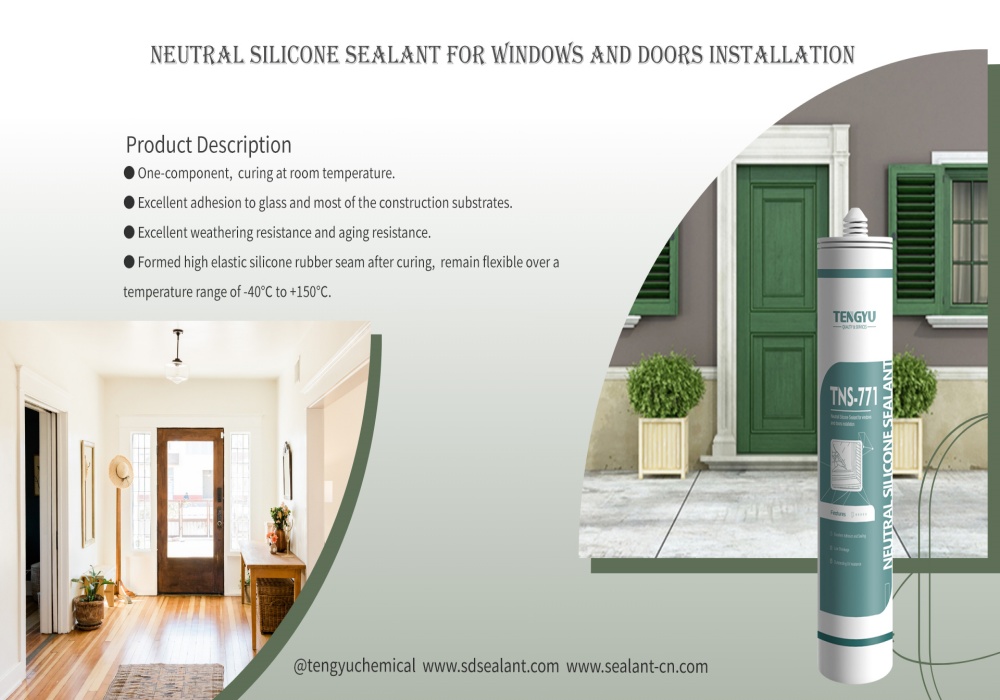
Silicone sealants are widely used in door and window installation. Their core function is to improve the comprehensive performance of doors and windows by sealing against water, wind, sound and enhancing structural stability.
”
Silicone sealants are widely used in door and window installation. Their core function is to improve the comprehensive performance of doors and windows by sealing against water, wind, sound and enhancing structural stability.
1. Main application scenarios
Frame and wall sealing
Filling the gaps between the door and window frames and the exterior walls, and between the window frames and the walls, prevents rainwater infiltration and air leakage, and improves air tightness and water tightness.
Glass and frame sealing
The inner and outer sides of the glass installation are sealed to fix the glass and prevent loosening, while isolating noise and dust.
Frame joint sealing
The outer connection position between the door and window frames and the frames enhances the overall structural strength and prevents deformation.
Corner injection can improve the stability of the main frame and provide basic protection for the load-bearing of glass and hardware.
2. Performance advantages
Strong weather resistance
Silicone sealants have excellent UV resistance and aging resistance, and can remain stable in an environment of -40℃ to 204℃, adapting to different climatic conditions.
Elasticity and displacement capacity
Can withstand changes in the width of the joints (such as deformation of doors and windows due to temperature changes), prevent cracking, and ensure long-term sealing effect.
Wide range of adhesiveness
Applicable to a variety of materials such as glass, metal, aluminum, tiles, plexiglass, coated glass, and no primer is required for most substrates.
Waterproof and mildew-proof
Mold-proof silicone sealants can be used in humid environments such as bathrooms and kitchens to inhibit mold growth.
3. Construction points
Substrate treatment
Cleaning the surface: remove oil, dust, and water stains, and ensure that it is dry and free of impurities.
Compatibility test: Confirm the adhesion of the sealant to the substrate and accessories before construction.
Glue type selection
Acidic glue: It cures quickly, but corrosive to metal and stone, and is suitable for non-metallic substrates.
Neutral glue: It has little odor and low corrosiveness, and is suitable for metal, stone and indoor environments.
4.Construction environment
Temperature: 4℃~40℃, humidity: 40%~80%.
Avoid construction on rainy days, snowy days or high temperatures to prevent bubbling or wrinkling.
Gluing tips
Glue joint design: depth is less than half of the width, no more than 1cm, to ensure full contact with air.
Glue fullness: moderate thickness, avoid cracking due to too thin.
Correction time: timely correction is required during high temperatures in summer to prevent the surface from drying too quickly and affecting flatness.
Related Articles
Quality Control in Sealant & Waterproof Coating Manufacturing | From Raw Materials to Finished Products
What Is No More Nails? No More Nails vs Silicone Sealant Explained
Silicone Sealant Yellowing: How to Avoid Discoloration in Clear Caulk
What Is No More Nails? Uses, Strength & How to Apply It
Floor Adhesives: A Comparative Guide to Acrylic, MS, and Polyurethane
You May Also Like
-
top Reco Quality Control in Sealant & Waterproof Coating Ma...

-
top Reco What Is No More Nails? No More Nails vs Silicone S...
nail free glue 
-
top Reco Silicone Sealant Yellowing: How to Avoid Discolora...
silicone sealant 
-
top Reco Which sealant is more mold resistant polyurethane ...
silicone sealant acrylic sealant pu sealant 
-
MS Polymer Wood Flooring Adhesive: Product Selecti...

-
Polyurethane waterproof concrete sealant Types: 1K...
construction materials Polyurethane sealant Factory & Manufacturer 
 Tina
Tina Tina
Tina
